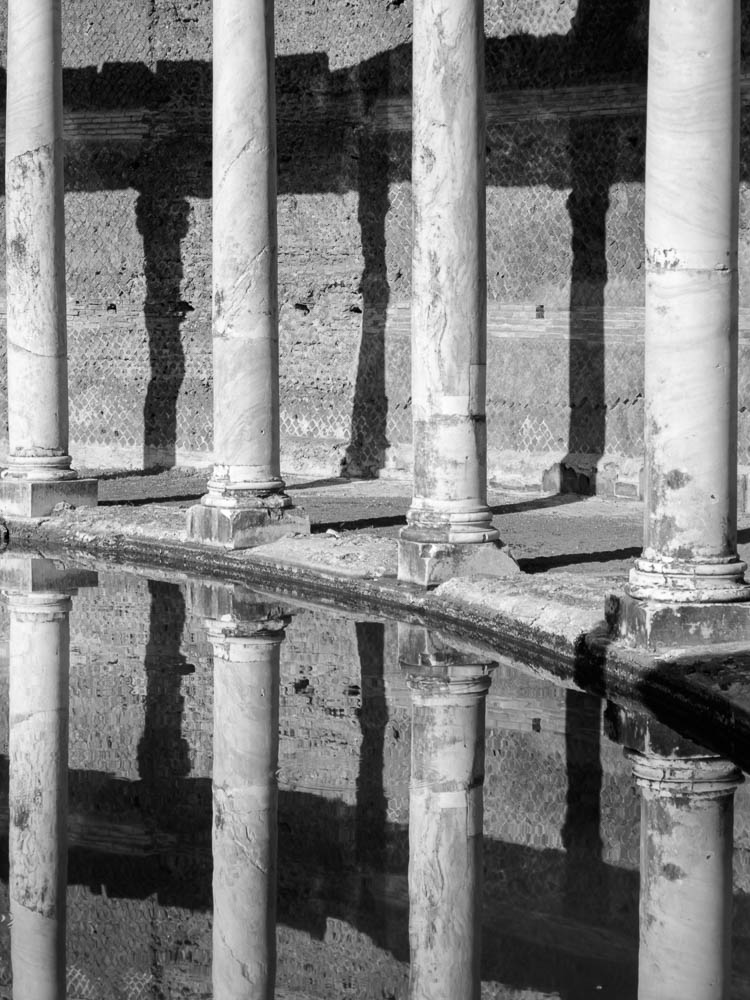
Hadrian (2018)
Lazio, Italy
Hadrian’s Villa was conceived as a refuge—a private world where an emperor could retreat from the demands of empire and contemplate something beyond the machinery of power. It was built as an act of profound indulgence, a landscape of water and stone designed to mirror the emperor’s own refined imagination.
The columns before us speak to that ambition. They rise with classical restraint, their proportions refined by centuries of Roman understanding. Yet here, isolated and reflected in still water, they become something more meditative. The geometry is perfect, almost austere. There is no decoration, no excess—just the purity of form repeated, mirrored, doubled by the water’s glassy surface.
In the end, what Hadrian built were monuments to transience itself, gardens that whispered about the impermanence of all human grandeur.